
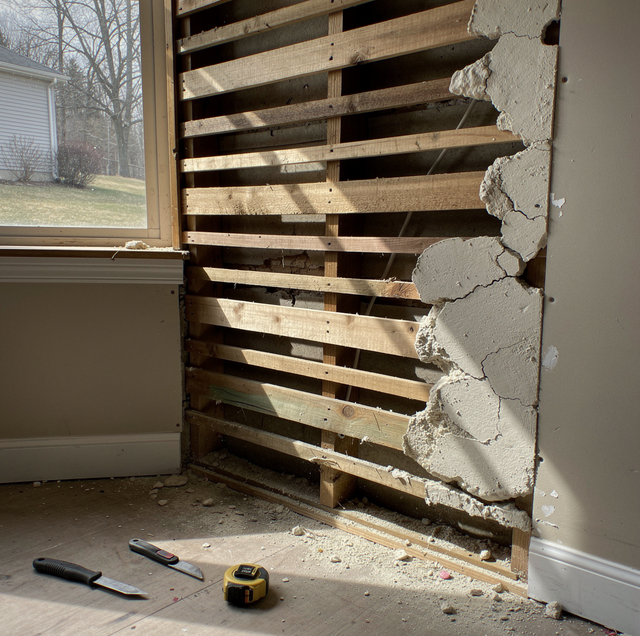
"Tear it all out and start with drywall" is one way to approach an older home renovation, and it gets settled before a wall has even been opened. It treats old plaster as a problem to be removed rather than a material to assess, and it skips a step: plaster and drywall are different systems, built differently and behaving differently when a wall is stressed, cut, or opened. What the wall is doing right now, not its age on its own, decides which outcome fits, and tearing out is only one of several.
How Plaster-and-Lath Walls Are Built, and How They Differ from Drywall
Wood lath consists of narrow strips nailed horizontally across the studs, with a gap left between each strip. The first coat of plaster goes on wet and squeezes through those gaps, and once it cures, the lumps on the back side, called keys, lock the coat to the lath with no fastener through the face. Two more coats build the finished surface over that base coat, so the wall ends up thicker than the half-inch or five-eighths-inch panel that fills the same place in newer construction.
Drywall works differently. A single sheet of gypsum core wrapped in paper is screwed directly to the studs, then taped and coated at the seams. There is no wet coat curing behind the surface and no mechanical grip into the framing; the screws themselves hold the panel in place. Painted, both read as flat walls, so the surface in front of you does not tell you which system is behind it.
What Plaster Does Well
Plaster's strengths come directly from being a solid, mineral-dense coat rather than a thin fastened sheet, and they are worth weighing before any of it comes down.
More mass in the same thickness is why a plaster wall blocks more sound than a panel wall: more material in a sound wave's path means less of it reaches the other side. Drywall, with a thin paper-faced core and an open cavity behind it, puts less material in that same path.
Gypsum plaster and drywall resist fire the same way: gypsum holds water bound into its crystal structure, and that water has to boil off before the material's temperature can climb any further, which slows heat moving through the wall. A thicker gypsum-plaster assembly puts more of that material between a fire and the framing behind it. Some older walls are lime plaster instead, which cures by a different chemistry and does not carry gypsum's bound water.
Plaster also takes an impact differently. Because it is a continuous, bonded coat, a stray knock meets solid material at the point of contact instead of a panel spanning the gap between screws. An impact that would punch through drywall's paper face chips or cracks a small area of plaster instead.
A wall's own condition sorts it into patch, skim, cover, or tear-out:
| Wall Condition | Fit | Why |
|---|---|---|
| Hairline cracks, plaster still bonded tight to the lath | Patch and blend | The bond is intact; only the surface needs work |
| Cracking is widespread across a wall that still sounds solid when tapped | Skim coat the whole wall | A thin finish coat across the whole wall resets the surface without disturbing a bond that is holding |
| Sections sound hollow or have pulled loose from the lath, but the framing underneath is sound | Cover with a new layer of drywall | The old plaster stays as backing; a thin panel goes over it without demolition |
| Plaster has failed broadly, or the wall is already being opened for wiring or plumbing | Tear out and replace with drywall | Nothing is left worth saving once the bond and the access reasons point the same way |
Where Plaster Fails
The keys that hold plaster to the lath are only as strong as the plaster itself, and that strength does not remain uniform throughout a wall's life. A section that has taken enough vibration, a slammed door, a dropped tool, decades of a house settling can shear its keys off the back of the lath while the front coat stays intact and painted, so the wall looks whole even though it is no longer attached to anything behind it. Pressing on that section gives slightly, and it sounds different under a knuckle: a dull, resonant thud instead of the flat, solid tap of plaster still keyed to the lath.
A bulge is that same failure spread across a wider area: the coat has pulled away from the lath over a section large enough to flex when you touch it, and the paint over a bulge can show a fine crack pattern where the surface is stressed. Cracks that follow a stud line or run at a consistent angle from the corner of a door or window can indicate the framing moving beneath; a lath joint behind the coat can also crack the plaster along a straight line. A crack that wanders and branches without following any line in the framing is more consistent with plain surface aging.
Repair, Skim Coat, Cover with Drywall, or Tear Out
The house's age changes this decision in one way. An older home may still be standing on its original plaster and lath, and in each case, the outcome is a live choice, because the old coat can stay as a surface or as backing. A house that went up with drywall from the start has no plaster to keep, so a damaged section is cut out, and a new piece of panel goes in.
Sanding a crack for a patch, skim coating, and opening a wall for tear-out are the actions that turn a stable material into airborne dust, so painted surfaces get tested before any of that starts. That holds in any older home, drywall walls included, because a wall's paint can date from the lead-paint era, whatever it was applied over. Dust containment is set up before the first cut, with the work area enclosed behind plastic sheeting.
Older paint can carry lead on plaster and drywall alike, and old plaster or joint compound can carry asbestos. Leave suspect material undisturbed until a testing professional has sampled it; if the result is positive, an abatement contractor handles removal.
Once that step is clear, the four outcomes split on two questions: is the plaster still bonded to the lath, and is the wall already being opened for another reason? A crack in an otherwise solid wall is a surface repair: fill it, span it with a strip of fiberglass mesh so the same stress that opened it once is less likely to reopen it, then blend the patch into the surrounding texture. A wall that is solid but tired across its whole surface, carrying a network of hairline cracks rather than a single clean line, gets a full skim coat instead of patch after patch: one thin finish coat gives a continuous surface instead of a patchwork of small repairs feathered into the old material.
A wall where sections have let go of the lath, but the studs and wiring behind them are not the reason the wall is open, is where covering makes sense: a new layer of drywall goes directly over the old plaster, using it as backing rather than removing it. That route keeps demolition and its dust out of the project, at the cost of a slightly deeper wall, door, and window casings that may need to be extended to meet it.
Tearing out earns its place once the plaster has failed broadly enough that patching or covering would be fixing a wall that keeps failing, or once the wall is already coming open to reach wiring, plumbing, or insulation the renovation needs anyway.
What Opening a Wall in an Older Home Can Reveal
Once a wall is open, what is behind it is no longer a guess.
Wiring is the most consequential find. Knob-and-tube wiring runs each conductor separately, supported through the frame on ceramic knobs and through tubes, without a grounding conductor and without the sheathing later wiring methods use. Undisturbed knob-and-tube is not automatically a hazard, but its condition cannot be judged by looking through the opening: cracked insulation, added splices, or contact with insulation packed in around it later all change what has to happen next. A run of knob-and-tube found behind an opened wall is an electrician's job before that wall closes again.
Insulation, or its absence, is the other find to plan for. A wall built before insulation was standard in exterior framing can be empty inside the cavity, with only the plaster and the exterior sheathing keeping outside temperature out. That gap does not announce itself from the room side; it shows up as a wall that stays cold to the touch compared with the wall beside it, and an open wall lets the whole cavity be filled and checked before it closes.
Planning the Work
Testing comes first, before a demolition date gets set, because a positive result changes the schedule and adds its own contractor to the sequence. After that, the order runs section by section rather than for the whole house at once, since a house built or added to in stages can carry a section of sound plaster right beside one that has already failed. Return vents in the work area get covered along with the doorways, so plaster dust stays in the room being worked on instead of riding the air system into other rooms.
Frequently Asked Questions
Small loose areas can be. Thin plaster washers, driven with screws through the coat into the lath or studs, pull a sagging section back tight, and adhesive injected behind the coat can rebond it before the washers are skimmed over. Where loose plaster runs across a broad area, covering or tear-out remains the route.
Turn off the breaker for that circuit, remove an outlet or switch cover plate, and look at the cut edge of the wall around the box. A layered, sandy edge, sometimes with wood strips behind it, is plaster; a thin gypsum core faced with paper on both sides is drywall.
It can, where a patch meets old plaster at a different thickness. Shimming the patch flush with the surrounding coat and taping the joint so the tape bridges both materials keeps a ridge from telegraphing through the paint.
Not quite. Ceiling plaster answers to gravity in a way wall plaster does not: its keys hold the coat's full weight hanging downward, so a ceiling section that has lost its grip on the lath is a falling hazard. It gets braced and re-secured, or taken down and replaced, before it is patched.
They can be. A run of decorative plaster can be masked off and worked around during a nearby repair rather than removed with the surrounding surface. If a section is damaged beyond saving, a mold can be taken from an intact matching piece elsewhere in the house and used to cast a replacement in the same profile.
Yes, and part of that can be won back while the wall is open. Batt insulation in the stud cavity dampens sound moving through the hollow space, drywall hung on resilient channel separates the panel from the studs, and a second layer of drywall adds mass back.
Line up plaster and drywall repair in an older home — patch, skim coat, drywall cover, or tear-out, matched wall by wall to how well the plaster still holds. M&D Home Renovations serves Delaware County and the Philadelphia suburbs. PA HIC #PA171802. Call (484) 250-4883.