
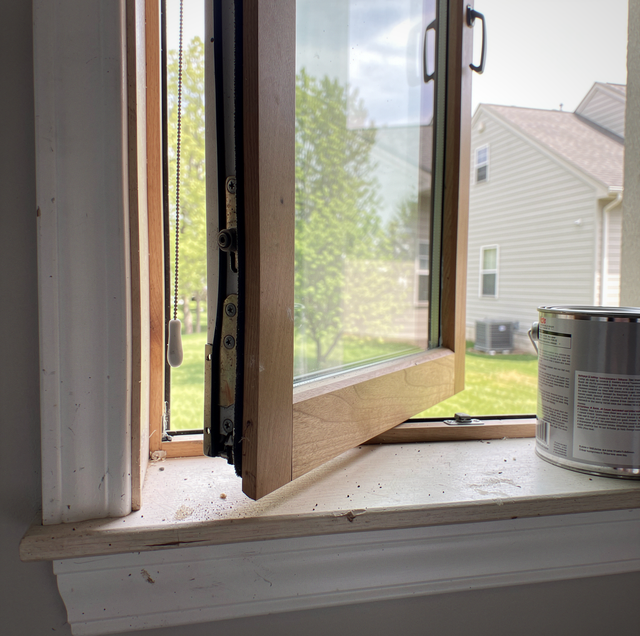
A window's moving parts and its glass unit fail on a different timeline than the frame that holds them, and that difference decides whether a fix is worth doing or the window needs to come out. A sash that won't stay up, a lock that won't catch, or a pane that has fogged between the glass are contained failures: the frame around them is sound, so the plan is to work on the failing part by itself. Rot that runs through the sill or lower frame, or a frame that has pulled out of square, is a structural failure: the frame itself has given way, and no repair to the glass or the hardware changes that. Placing a specific window in one category or the other is the first call in the decision.
Each sign pairs with its repair or replacement path:
| Sign | Path |
|---|---|
| Sash sticks or won't stay up | Repair: a worn cord, spring balance, or paint seal at the stop |
| Fogging or haze between the panes | Replace the glass unit or the sash: the seal has failed and can't be resealed |
| Soft or rotted wood at the sill or lower frame | Replace if rot runs through the sill or frame; a small localized spot can be cut out and patched |
| Draft felt right at the sash edge | Repair: new weatherstripping restores the seal |
| Draft felt around the whole frame, at the wall line | Replace: the frame or its seal against the opening has failed |
| Broken lock, crank, or hinge | Repair: hardware swaps out on its own |
| Single-pane glass with no other failure | Neither by default: an upgrade choice, not a repair-or-replace call |
What Can Be Repaired: Sash Cords, Balances, Weatherstripping, Glazing, Hardware
A double-hung sash hangs from a cord or chain that runs over a pulley to a counterweight, or from a spring balance built into the frame channel. When that cord frays or the balance loses tension, the sash won't hold its position or drops on its own, and a repair replaces the cord, chain, or balance without touching the sash or the frame around it. Weatherstripping compresses and wears at the point where the sash meets the frame; swapping it in restores the seal at that joint alone. On a single-pane sash, the glass sits in a bed of glazing compound held by small glazing points; when that compound dries out and cracks, the pane can rattle or let air through at its edge, and reglazing resets the pane without opening up anything else. Hardware (sash locks, casement cranks, hinges) wears mechanically on its own schedule and comes out as a self-contained part. None of these repairs touches the frame, which is why they stay contained.
When Rot or a Failed Insulated Unit Tips It to Replacement
Two failure types fall outside what a repair can reach. Rot that has spread through the sill or into the lower jambs has broken down the wood that carries the window; a small, localized soft spot can be cut out and patched, but rot running through the frame means the frame is replaced. A sealed insulated glass unit is built with a spacer holding the two panes apart and a factory seal at that spacer's edge keeping the gap between them dry; when that seal fails, humid air works its way into the gap, and the fogging that follows doesn't clear on its own because there's no way to reach inside a sealed unit to wipe it. On some windows, the sash carrying that failed glass unit can be replaced while the surrounding frame stays in place; on others, frame condition rules that out, and the whole window comes out. Either way, the fix is a new glass unit, a new sash, or a new frame; weatherstripping, hardware, or reglazing doesn't reach either failure.
Drafts at the Sash vs. the Frame
Where a draft is felt changes what it means. A draft right at the joint between the sash and the frame, where the moving part meets the fixed part, traces to worn weatherstripping or a lock that no longer pulls the meeting rails together, and a repair at that joint closes it. A draft felt further out, at the line where the frame itself meets the wall or trim, points somewhere else: the seal or insulation around the frame in the rough opening has failed, or the frame has shifted enough that it no longer sits tight in the opening. That second kind of draft isn't something weatherstripping reaches, because the gap isn't at the sash; it's around the whole unit. Confirming which one a specific window has involves tracing the draft by hand along both lines before deciding which path to take.
Older-Home Considerations: Original Sashes, Trim, and Opening Size
Older homes can have window openings sized to the sash that was installed, not to a stock size a supplier keeps on hand, and with trim and casing profiles milled to match. A replacement window built to a modern stock size can change the trim reveal or require the casing to be reset or remade to keep the same look. Where the wood in an original sash is still sound apart from one damaged section, that section can be cut out and spliced with new wood rather than replacing the whole sash. Original sashes built before the late 1970s were finished with paint that can contain lead, and disturbing that paint surface is where the real risk sits.
Sanding or scraping paint on an older window sash can release lead dust, a hazard where kids or pregnant occupants are present. Don't sand old paint yourself; a licensed renovator tests it first and contains the work when needed.
A heat gun run hot enough to scorch old paint can release lead fumes, and the softened paint still comes off the sash as lead-bearing chips, so heat stripping belongs in the same tested, contained job.
How the Decision Gets Made on a Walkthrough
A house built in one era doesn't age uniformly window by window: a window on a wall exposed to full sun and weather can be well past where a matching window on a shaded wall still sits. That's why the repair-or-replace call gets made window by window rather than for the house as a whole. During a walkthrough, each window is checked the same way: the sash is worked up and down or opened and closed to feel for binding, the sill and lower frame are checked for soft spots, the glass is checked for fogging, and the weatherstripping and hardware are checked for wear.
Before ruling a window in for repair, open and close it fully. A sash that binds partway up can signal a swollen frame rather than worn hardware, and that difference changes which fix applies to the window.
Frequently Asked Questions
On a single-pane sash, yes, and that repair stays contained to the pane itself. On a sash carrying a sealed insulated glass unit, the whole unit, spacer and all, has to come out and be replaced together; there's no way to swap just the outer or inner pane on its own.
A sash repair involves removing the interior stop and lifting out the movable sash, so the casing and any exterior brickmold stay in place. A full-frame replacement removes the sash and frame together and resets or rebuilds the casing; an insert replacement fits a new unit inside the old frame, leaving the trim alone at the cost of some glass area.
No. Fogging between the panes comes from a broken seal at the spacer edge, not a crack in the glass; humid air gets into the sealed gap and condenses on the inside surfaces where nothing can wipe it away. The desiccant packed inside that spacer is what keeps that gap dry, and once it's saturated, it can't absorb any more, which is why the fog doesn't clear on its own.
Casement hardware fails differently. The crank turns a geared operator mounted at the sill, with a single or scissor arm running to the sash; when the crank spins freely, but the sash doesn't move, the gear inside the operator has stripped. The operator comes out and is replaced as a single part without removing the sash, keeping a casement hardware repair as contained as a double-hung cord or balance job.
Older double-hung windows carry a cast-iron counterweight on the far end of each sash cord, hanging inside a pocket built into the frame. The pocket is reached through a removable access panel in the jamb, so a cord is replaced without taking the frame apart; if the jamb wood around that panel is soft from water, that wood is repaired before the new cord goes in.
Not always, but they can share one cause. A sash worn loose in its channel can rattle and leak air along the same gap at once, so one loose sash can produce both symptoms; a rattle with no felt draft traces instead points to a loose glazing point.
Arrange window repair or replacement — each window is checked on a walkthrough and either repaired in place or replaced. M&D Home Renovations serves Delaware County and the Philadelphia suburbs. PA HIC #PA171802. Call (484) 250-4883.