
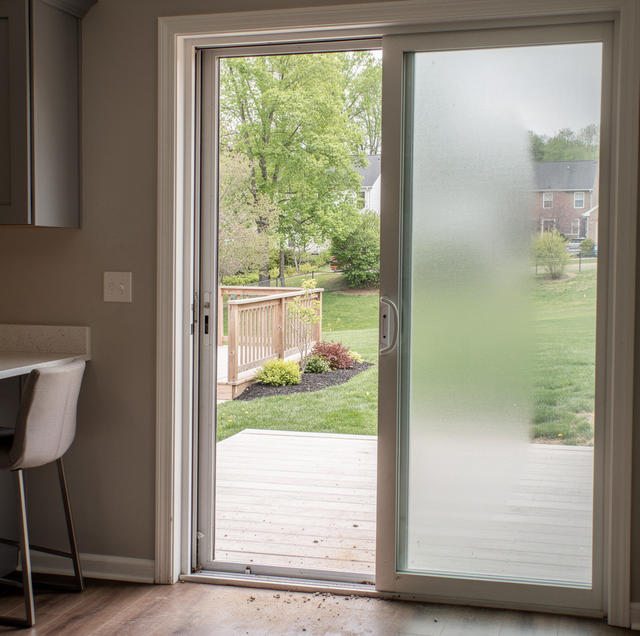
A sliding patio door and a French patio door open in two different ways, and that mechanical difference decides what follows. A sliding door's panel rides on rollers along a track and travels sideways past a fixed panel, so the door never swings into the room or out onto the patio. A French door's leaves hang on hinges at the jamb and swing open the way any hinged door does. Floor space in front of the doorway, how wide the opening gets once the door is open, and how the door closes against wind and rain all follow from that one difference between rolling and swinging.
A two-panel slider and a two-leaf French door compare this way across opening, clearance, sealing, screens, and locking:
| Point | Sliding Door | French Door |
|---|---|---|
| How it opens | One panel rolls sideways on a track | Both leaves swing open on hinges |
| How much of the frame opens | Half the frame width, since one panel stays fixed | Nearly the whole frame width once both leaves are open |
| Clearance needed in front | None beyond the room the panel itself takes up while it travels | A swing arc in front of the door, sized to each leaf |
| Where the weather seal sits | Along the track and jambs, closing against the moving panel | Around the jamb, plus a seal where the two leaves meet |
| Screen options | A separate screen panel on its own track | A retractable or hinged screen mounted apart from the door |
| Hardware and locking | A latch and lock set into the operating panel's edge | A lockset on the active leaf, plus separate hardware securing the inactive leaf in place |
The Swing Zone and the Furniture in Front of It
A French door can be hung to swing in (into the room) or out (onto the patio), and that choice is made when the door is ordered. An inswing door needs clear floor space inside the room for the leaves to travel through; furniture, a rug edge, or a kitchen island placed too close blocks the door from opening fully. An outswing door moves that same clearance requirement outside, onto the patio or deck, where a grill, a table, or a planter can just as easily sit in the path. A sliding door requires neither kind of clearance: the panel travels sideways within the width of the doorway itself, so nothing needs to be kept clear in front of it on either side.
A French door's swing arc reaches well past the space a closed door needs, and furniture that clears the closed door can still sit inside that arc. Taping the arc's outline on the floor before ordering shows what has to move.
Opening Width and Carrying Things Through
Opening width comes into play when something wide has to go through the doorway: a piece of furniture, a grill, a folded patio table. A two-panel sliding door opens to the width of one panel, since the other panel stays fixed in the frame and the moving panel can only travel as far as the fixed one allows. A pair of French door leaves, both swung open, clears nearly the whole frame width, because neither leaf occupies any of the opening once it is pushed back against the wall or jamb. For everyday traffic, a person walking through or a pet going in and out, the width of one moving panel is enough. For anything sized to need the full opening, the choice between the two doors decides whether it fits.
How Each Door Seals Against Wind and Rain
A French door seals by compression: the leaf presses against weatherstripping set into the jamb all the way around, and where the two leaves meet in the middle, a strip on the astragal, the vertical piece attached to the inactive leaf, closes that joint the same way. Closing the door draws the leaf tight against that seal, the way any hinged door does. A sliding door cannot press against its seal the same way, because the panel keeps moving parallel to the frame right up until it stops; instead, a brush or pile seal, a dense strip of fibers set into the track and jambs, brushes against the panel's face as it slides and closes off the gap once the panel stops. Both approaches fully close a doorway once it is shut; where they differ is what happens while the door is in motion, since a swinging leaf clears its seal entirely when open, and a sliding panel stays close to its seal the whole time it travels.
The Sliding French Door as the In-Between Choice
A sliding French door is a third option: leaves styled and divided to resemble a French door's individual panes, but hung from tracks at the top and bottom so they slide rather than swing. It is built for an opening where a full French door's swing arc will not fit, a narrow patio, a tight corner, or a walkway close to the door, while still giving a look closer to French doors than to a standard two-panel slider. The panels still travel past each other along a track, the same way a standard slider's panels do, so its opening width and clearance follow a sliding door's, with no swing arc. Where an existing opening is too narrow for the door being considered, whichever type it is, widening it affects the framing around the opening, and, depending on what is involved, a local building department's permitting process determines whether that work requires a permit.
Door panels are heavy, and an insulated leaf holds two or more panes. A dropped or cracked panel can cut and crush, so an installation crew removes it, and a cracked door stays shut and out of traffic until then.
Track, Threshold, and Upkeep
A sliding door's track collects grit, leaves, and sand blown in from outside, and debris in the track is one cause of rollers sticking or a panel dragging; worn or misaligned rollers are another. Running a vacuum or a stiff brush along the track keeps the rollers riding clean. A French door's threshold serves different functions: a raised sill with a sweep along the bottom of each leaf closes the gap at the floor, and that sweep gradually wears down with regular use. On some French doors, the threshold cap is adjustable, raised by turning screws along the sill so the sweeps meet it again as they wear. Rollers on a sliding door wear too, and on some models they can be adjusted or swapped without replacing the panel that carries them. Hinges on a French door take the full weight of the leaf every time it swings, so a door that starts to drag against the frame or that will not latch squarely can mean a hinge has loosened, the leaf has sagged, or the frame has shifted out of square.
Choosing by Room
A kitchen opening onto a patio carries daily traffic, hands full of plates or a grill tray, and the width a two-panel slider gives up is the width a French door gives back. A household that carries things through that doorway can put real use to the wider opening, while one that walks through with empty hands gives up nothing it uses with a slider. Where a living room's furniture already sits near the doorway- a sofa, a console, a media unit- that is the spot where a French door's swing zone competes for the same space; a sliding door leaves that layout alone. A narrow deck or balcony off a bedroom leaves little room for a swing arc on either side, which is where a sliding door, or a sliding French door where the look matters, fits a space a hinged pair cannot.
Frequently Asked Questions
On some units, yes: the operating and fixed panels can be swapped within the frame before installation. On others, handing, which panel rolls, is set at the factory, and switching it means a new unit.
Flush bolts recessed into the top and bottom edges of the inactive leaf drive into the head jamb and the sill, holding it shut independently of the lockset on the active leaf that is used every day.
Yes. Three- and four-panel sliding systems exist, and in a stacking design, the moving panels slide back behind a fixed panel, opening more of the frame than a single moving panel beside a fixed panel can.
No. The astragal is a separate strip attached to the edge of the inactive leaf, and both the strip and the weatherstripping set into it can be replaced individually without replacing either door leaf.
Weep holes along the sill's outer edge let water that reaches the track drain back outside before it can pool against the door.
On some lines the hinges are reversible, and the leaf can be rehung on the other jamb; on others the frame and leaf are built handed at the factory, and switching sides means a new unit, so handing is worth confirming before the door is ordered.
Bring in patio door installation —sliding or French—a two-panel slider, a hinged French pair, or a sliding French door when clearance is limited. M&D Home Renovations serves Delaware County and the Philadelphia suburbs. PA HIC #PA171802. Call (484) 250-4883.