
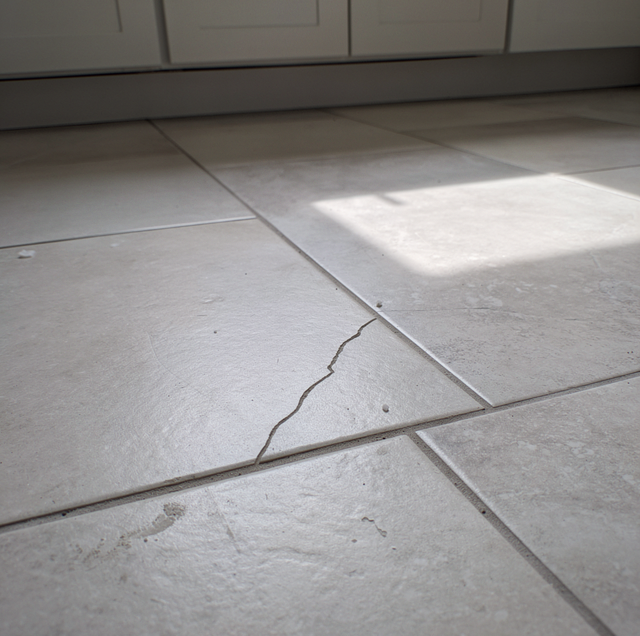
Run a knuckle across your tile floor and listen. Across the field you get a short, dead tick. Then, near a doorway or out in the middle of the room, the note changes: higher, ringing, carrying longer than the tick beside it. Where it changes, the tile has lost continuous contact with what lies beneath it: a void or a layer placed there on purpose. The difference from the rest of your floor is what to follow.
Start there: it is the one check you can make without opening the floor. Tile is rigid and bonded to whatever sits beneath it, and it fails when that thing moves in a way it cannot keep up with. A cracked tile over a sound bed is a contained job. A joint emptying itself onto a flexing floor will empty again, however carefully you refill it, and the layer below the tile is what separates them.
The Sound of a Tapped Tile Is a Bond Test
A tile bedded in mortar across its whole underside has nowhere to vibrate, so the strike goes into the setting bed with no ring. A tile with an air gap under part of it flexes across that gap, and the flexing is the higher note.
Contact behind the tile is specified in a quantity. The installation standard for cement-mortar-set tile puts it at 80 percent behind a tile in a dry interior area and 95 percent where the floor is wet or exterior, with the corners and edges supported. Tiles pressed onto five separate dabs look perfect the day they are set and leave every corner unsupported.
Porcelain and ceramic are strong in compression and weak in tension, so an unsupported tile bridging a void goes into tension underneath each time your weight crosses it. The crack starts on the face you cannot see, which is why a tile that has sounded hollow for a year splits under an ordinary footstep.
Deflection Is a Floor Moving More Than Tile Can Follow
Wood-framed floors bend under load, and your tile rides on whatever they do. The limit is a fraction of the span: L/360 for ceramic and porcelain, L/720 for natural stone, under total design load, applied to the whole floor system. Over a 12-foot span, 144 inches divided by 360 is four-tenths of an inch of movement at midspan.
Cracks run parallel to the joists over a bay that flexes, or gather in the open middle of a span while the tile over the bearing walls stays whole. When the pattern maps onto the framing instead of the room, the framing is your source.
An older house gives that more room: joists sized for the loads of their era and a plank subfloor where a tile floor would want a stiffer deck. Season adds to it: a crawl space runs damp through a humid summer and dry through a heated winter, and the framing follows. If your hairline joints open in one season and close in another, you are watching that cycle.
A Crack That Runs Straight Through Tile and Grout Alike
Some cracks ignore the tile layout: the line crosses a tile, crosses the grout joint at its edge, crosses the next tile, and keeps going straight. A grout joint is the compliant line in the assembly, so a failure beginning in the tile finds it and stops there. A crack treating that joint as though it were not there is driven from underneath, by a plane running continuously beneath both.
Over a slab, that plane is the concrete: a shrinkage crack from curing, or a saw-cut control joint tiled straight over, telegraphing up through the bond. You can look for the same line where the slab is exposed in an adjacent room. Over a wood floor, the equivalent is a moving seam between subfloor panels.
A crack isolation membrane, built to the standard for that product category, bonds to the substrate and is rated for movement in the plane of the floor, so the two sides of a crack slide while your tile stays whole. One side rising above the other is a different situation than when nothing bonded above a slab changes.
A Tile Field Needs Somewhere to Go
Everything in the assembly changes dimension, and not at the same rate: porcelain moves very little with temperature, while the wood or concrete carrying it moves with both temperature and moisture. Bond a field edge to edge, run it hard against your walls and your tub curb, and that difference has nowhere to go.
The field is squeezed between its restraints; the grout powders out first as the softest material in the assembly, and if the squeeze keeps building, the field lifts off the substrate along a line.
A movement joint interrupts that continuity on purpose: a gap left open through the tile and the setting bed, filled with a flexible sealant so the field has somewhere to expand. Fill it with grout, and it stops being a movement joint, because grout is a rigid cement mortar and carries compression across the gap as tile would. If your floor is peaking along a line, look at what the field is pressing against.
Is Your Loose Grout a Grout Problem?
Grout is a Portland-cement mortar with fine aggregate; it carries no structural load, and it bonds to the cut edges of the tile only weakly. When two neighboring tiles move against each other by a fraction of a millimeter, the joint is subjected to compression and shear in every cycle, and the cement in that duty crumbles from the shoulders inward. The shape gives it away: a joint gone to sand at its edges while the middle is intact has been ground, not washed out.
So a run of joints emptying in the same place has a movement source under it.
Grout has its own failures, and they look different on your floor. A joint underfilled at installation leaves grout a few millimeters deep in a joint many millimeters tall, with nothing anchoring it, and grout sponged too hard while it was still curing loses cement paste out of the surface and leaves a chalky skin that powders under your fingernail. Those show up early and across the entire floor rather than along a single line.
Hold your phone's flashlight against the floor and sight along a failed joint between tiles set together. If both edges stay in one plane and only the grout is gone, the joint failed. If one throws a shadow, what supports it moved.
What Separates a Tile Replaced From a Floor Taken Up
A single cracked tile in a bed that taps solid all around it is a contained repair: cut the grout out around it, wet or with dust extraction, break the tile from the center outward so the neighbors are never levered, chisel the old mortar back to a flat plane, and set a replacement with full contact. Nothing under it changed, so nothing under it moves. A failed joint over a sound bed is the same job: rake the joint out toward the full depth of the tile, again wet or with extraction, clear the debris with a HEPA-filtered vacuum, and refill.
Dry-cutting or chiseling tile and cement grout releases respirable crystalline silica. Wet the cut or run dust extraction, and clear debris with a HEPA-filtered vacuum; a shop vac without that filter puts the finest fraction back into the room.
Regrouting a floor that deflects puts your joint back into service on the day you use the room, and replacing one cracked tile in a field that taps hollow leaves every neighbor still spanning air. In both, the work went into a layer that was never the source.
Which is why your question is settled at the substrate. Stiffening a floor system means reaching the joists from below or rebuilding up from the subfloor; isolating a slab crack means bonding a membrane to the slab. Neither is reachable through the joint you were going to rake out. From below, that work is sistering: a second joist fastened along the full length of the old one and bearing at both ends on the same two supports, with your tile never coming off.
Frequently Asked Questions
Yes, when the surrounding bed is sound. The harder part is matching. Tile is made in production runs, and the carton carries a shade code and a caliper code, the caliper being the size batch, because fired tile varies by a millimeter or two between runs. A replacement from another run can look different in color against your floor or sit proud of it. Keep a spare box from your original installation.
A corner is a change of plane in which two surfaces move independently. Where your floor meets a wall, or tile meets a tub, that joint belongs to a flexible sealant rather than grout. A standard specification governs those sealants, and silicone and urethane products that meet it remain elastic and stretch with movement rather than split.
Not automatically. A tile set over an uncoupling or waterproofing membrane sounds hollower than one set directly on concrete, because the membrane is a deliberate discontinuity that changes how your tap carries. That is a normal floor. What matters is whether the sound differs from the rest of that floor, whether the tile clicks under your weight, and whether the hollow area has spread to its neighbors since last year.
Concrete shrinks as it dries, and a crack opened by that shrinkage stops widening once the slab reaches equilibrium with the surrounding room. Whether yours has is something you measure. A crack monitor, a two-part graduated gauge glued across the crack and read in millimeters over several months, shows whether the two sides still move and in which direction. Those numbers change what any repair above it has to survive.
It can, and cement grout will not stop it. Grout is water-permeable, and a sealer slows surface absorption without making the joint a barrier. Waterproofing in a tile assembly is a separate bonded layer, built to the standard for load-bearing membranes and installed under the tile before anything is set. If your floor has one and it is intact, a cracked tile stays a surface problem. If not, a crack in a wet room is a path.
The tile industry has a standard detail for this. Indoors and out of direct sun, it places field joints every 20 to 25 feet in each direction, closing to 8 to 12 feet where your tile takes direct sunlight through glass or gets wet. At the perimeter, where your field meets a wall, it calls for a gap of at least a quarter inch, carried through the setting bed and filled with sealant rather than grout.
Your floor answers this on-site — a tapped field, a crack pattern, and a deflection check tell you whether you are looking at a repair or a floor. M&D Home Renovations serves Delaware County and the Philadelphia suburbs. PA HIC #PA171802. Call (484) 250-4883.