
Remodel or Reface Your Kitchen? How to Decide
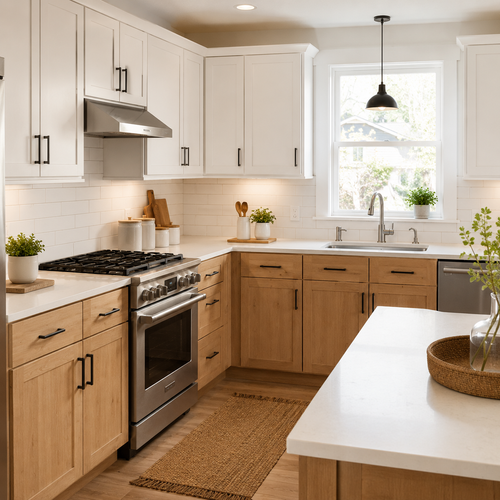
Quick Answer: Reface when your cabinet boxes are solid and the layout already works — you keep the boxes, swap the doors, drawer fronts, and veneer, and you're done in a few days for a fraction of the cost. Remodel when the layout fights you, the boxes are damaged or water-swollen, or you want to move the sink, range, or add an island. The quick test: if you'd keep the floor plan and just want it to look new, reface; if you'd redraw the kitchen, remodel.
You stand in your kitchen, look at the tired cabinet doors, and do the math two completely different ways. One version keeps everything where it is and just makes it look new. The other tears it down to the studs. They're priced worlds apart, and they solve different problems, so before you call anyone, it helps to know which problem you actually have.
Refacing and Remodeling Aren't the Same Job
Refacing keeps your existing cabinet boxes in place. A crew replaces the doors and drawer fronts and covers the visible box framework with a matching veneer, so the kitchen looks new while the bones stay exactly where they were. Because nothing structural moves, it's quick — often three to five days — and it costs a fraction of a full remodel.
A remodel changes the bones. New cabinets, a new layout, and often new plumbing and electrical to match. That's the route when you want the island you've never had, the sink under the window, or the wall between the kitchen and dining room gone. It costs more and takes weeks instead of days, but it's the only path that changes how the kitchen actually works.
The Question That Decides It: Do the Boxes and Layout Work?
Everything comes down to two checks. First, the boxes. Refacing only works on cabinet boxes that are structurally sound — the new doors and veneer need a solid foundation to attach to. If your boxes are water-swollen under the sink, sagging, or falling apart, there's nothing dependable to reface, and replacement is the honest answer.
Second, the layout. Refacing cannot move anything. If the work triangle is awkward, the fridge door bangs the counter, or you've always wanted to relocate the range, no amount of new doors fixes that — you need a remodel. But if you walk the kitchen every day and the flow is fine, you're just looking at dated surfaces, then refacing solves the real problem without the upheaval.
| Choose refacing when… | Choose a remodel when… |
|---|---|
| The boxes are solid and dry | Boxes are damaged, swollen, or sagging |
| The layout already works for you | The layout fights you daily |
| You want a new look, fast | You want to move the sink, range, or walls |
| You're prepping to sell soon | You're staying long-term and want it right |
| Budget and timeline are tight | You're ready to invest in a full change |
There's a Third Option People Forget
Refacing and remodeling aren't the only two lanes. If the doors are solid wood and structurally fine and you only dislike the color, refinishing or repainting them is cheaper still — though a painted finish typically holds up around 5 to 7 years before it shows wear, where a quality reface lasts roughly 15 to 20, and new cabinets 20 to 30 or more. There's also a hybrid: reface most of the kitchen and replace only the few damaged boxes or reface and add a freestanding island for storage you don't currently have. The right move isn't always all-or-nothing.
What the Resale Math Says
If resale is part of your thinking, the numbers favor restraint. In the 2025 Cost vs. Value Report, a minor midrange kitchen remodel recouped about 113% of its cost at resale nationally — you got back more than you spent — while a major midrange kitchen remodel recouped around 51%, and an upscale major kitchen about 36%. In plain terms, the modest update tends to pay for itself, and the gut-to-the-studs project rarely returns what it costs when you sell. That's a strong argument for refacing or a minor refresh if you're updating mainly to list the house, and for a full remodel only when you're staying long enough to enjoy it.
The Older-Home Wrinkle
Around Delaware County, many kitchens are in homes built well before 1950, which changes the calculus once the cabinets come off. A remodel in an older home often uncovers things a reface would have quietly left buried — ungrounded two-prong wiring or old knob-and-tube, a missing GFCI outlet at the counter that current code calls for, plaster-and-lath behind the cabinets, and walls that aren't quite square. None of that is a reason to avoid a remodel; it's a reason to go in with eyes open. If your boxes are sound and you only want a fresher look, refacing sidesteps all of it. If you're opening up the kitchen anyway, it's the right moment to bring those older systems up to date. An honest in-home assessment is the fastest way to find out what's behind the cabinets before you commit.
Frequently Asked Questions
It's worth it when the boxes are solid, and the layout works — you get a new-looking kitchen for far less than replacement, in days instead of weeks. It's a waste only when you reface boxes that are failing or a layout you'll keep resenting, because then you've spent money without solving the real problem. Match the fix to what's actually wrong.
Refacing generally costs significantly less than a full replacement — often only a fraction of the price, since you're keeping the cabinet boxes and replacing only the visible surfaces. The exact difference depends on your kitchen's size and the materials you choose, so the real comparison comes from quotes on your specific project. The bigger savings are often, too: refacing is faster and keeps the kitchen usable while the work is done.
No. Refacing keeps every cabinet exactly where it is — it only changes the doors, fronts, and visible surfaces. If you want to move the sink, relocate the range, add an island, or take down a wall, that's a remodel. Layout changes are the clearest line between the two.
Not reliably. Refacing needs structurally sound boxes to attach the new doors and veneer to. If the boxes are swollen or rotted from a leak, the new faces are only as good as the failing box behind them. Damaged boxes should be replaced, even if it's just the few under the sink.
Refacing is usually three to five days, and the kitchen stays mostly usable. A full remodel commonly runs several weeks, with the kitchen out of commission for a good stretch of it. If downtime is a major concern, that gap is worth weighing as heavily as the cost.
A modest update tends to return the most. National resale data shows minor kitchen updates recouping more of their cost than major remodels, which return roughly half. If you're updating to sell, refacing or a minor refresh is usually the smarter spend; a full remodel makes more sense when you'll be living in it for years.
The reface-versus-remodel decision isn't about budget first — it's about what's actually wrong with your kitchen. Sound boxes and a layout you like point to refacing. Failing boxes or a floor plan you'd redraw point to a remodel. Get that diagnosis right, and you won't overspend on a gut job you didn't need, or underspend on a reface that leaves the real problem in place.
Not sure whether your kitchen needs a reface or a full remodel? — Get an honest in-home look at your cabinets, layout, and what's behind them before you spend. M&D Home Renovations serves Delaware County and the Philadelphia suburbs. PA HIC #PA171802. Call (484) 250-4883.
